Education Projects

ECD and Skills Development Strategy The Silk Road Centre developed a five-year strategy for Rupani Foundation (RF), which is working with underdeveloped and marginalized communities in Sindh and Gilgit-Baltistan to implement Early Childhood Development (ECD) and skills development programs. These programs are supported through individual donations and funding from European Union, USAID, GIZ and Plan…
People-to-People Exchange Projects

New Perspectives on Gandhara and Cultural Cooperation among the Silk Road Countries The Silk Road Centre in collaboration with Zhejiang University and Tsinghua University of China, the Higher Education Commission of Pakistan and Taxila Institute of Asian Civilizations at Quaid-i-Azam University organized a 2-day online conference to exchange knowledge and research on the cultures of…

Revitalizing Cultural Heritage

Why to Protect Cultural Heritage? Cultural heritage whether tangible in the form of ancient sites and historic structures or intangible as in language, beliefs, rituals, traditions, music, dance, folktales and arts, represents historical and cultural development of humanity. Cultural heritage reinforces our identity and who we are as people. In a globalized world, which means…

Informing Culture & Heritage Policies

Policies to Promote Cultural Pluralism The Constitution of Pakistan envisages a pluralistic society by guaranteeing fundamental rights of its citizens belonging to any class or creed. These fundamental rights include equality of status, of opportunity, and freedom of belief, faith, worship and association. Article 27 of the Constitution safeguards representation of marginalized and disadvantaged groups…

Supporting Heritage Education & Learning

  Why Heritage Education and Learning? Very few people in Pakistan know that Badeshi, Bagri, Balti, Burushaski, Dehwari, Chilliso, Domaaki, Khowar, Kundal Shahi, Shina, Ormuri, Ushojo, Wakhi, and Yidgha, are among the indigenous languages of Pakistan. According to the well-known Pakistani scholar Dr. Tariq Rahman, Pakistan has six major and over fifty-nine small languages, some…

Facilitating Cross-Cultural Understanding & Dialogue

The Rationale The age old traditions and values in a largely interconnected world seem to be shaken by modernizing influences. The cultures and value systems of the developing world, in particular, are being challenged by the process of globalization. Strategically located countries of South and Central Asia are no exception. These countries, under the growing…

Our Leadership

  Advisory Council Miangul Adnan Aurangzeb, Scholar and former Member, National Assembly of Pakistan Dr. Ghani Ur Rehman, Professor, Taxila Institute of Asian Civilizations, Quaid-i-Azam University, Islamabad Ibrar Hussain Shah, Project Engineer, Aga Khan Planning and Building Service, Pakistan Salman Muhammad, Documentation Specialist, Abu Dhabi Authority for Culture and Heritage Rubina Nabi, Civil Engineer, Pak-China Mobile Company, Islamabad…

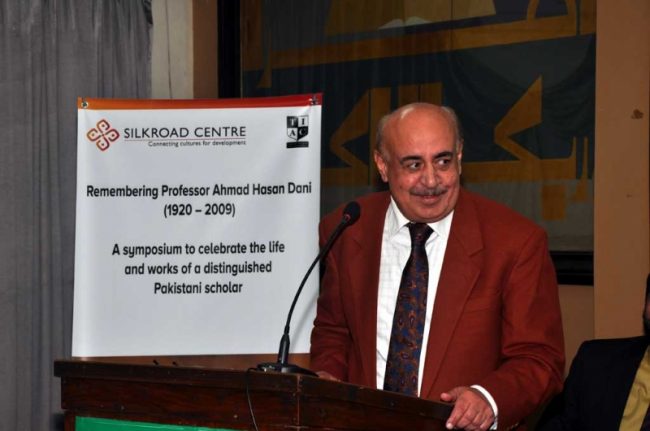
Remembering Professor Ahmad Hasan Dani

Professor Ahmad Hasan Dani was a prominent archaeologist, historian and linguist. From the discovery of ancient rock art from the Karakoram Mountains in Gilgit Baltistan to explorations in Balochitsan, Professor Dani shone light on the cultural heritage of Pakistan. He authored over

Our Logo

Our Logo Our logo is derived from a sixth century silk motif found on fabrics excavated at Turfan in China. The logo symbolizes the wondrous products, both material and intellectual, travelled along the fabled Silk Road. For centuries this network of land and sea routes connected cultures of East and West. Combination of two colors…

Mission & Vision

Mission & Vision The Silk Road Centre is a nonprofit educational and cultural organization that develops educational activities and materials and engages in research, collaboration and exchanges to promote cultural heritage, education and civil society for peace and progress. Our Mission The Silk Road Centre is a forum for promoting peace and progress through intellectual…